
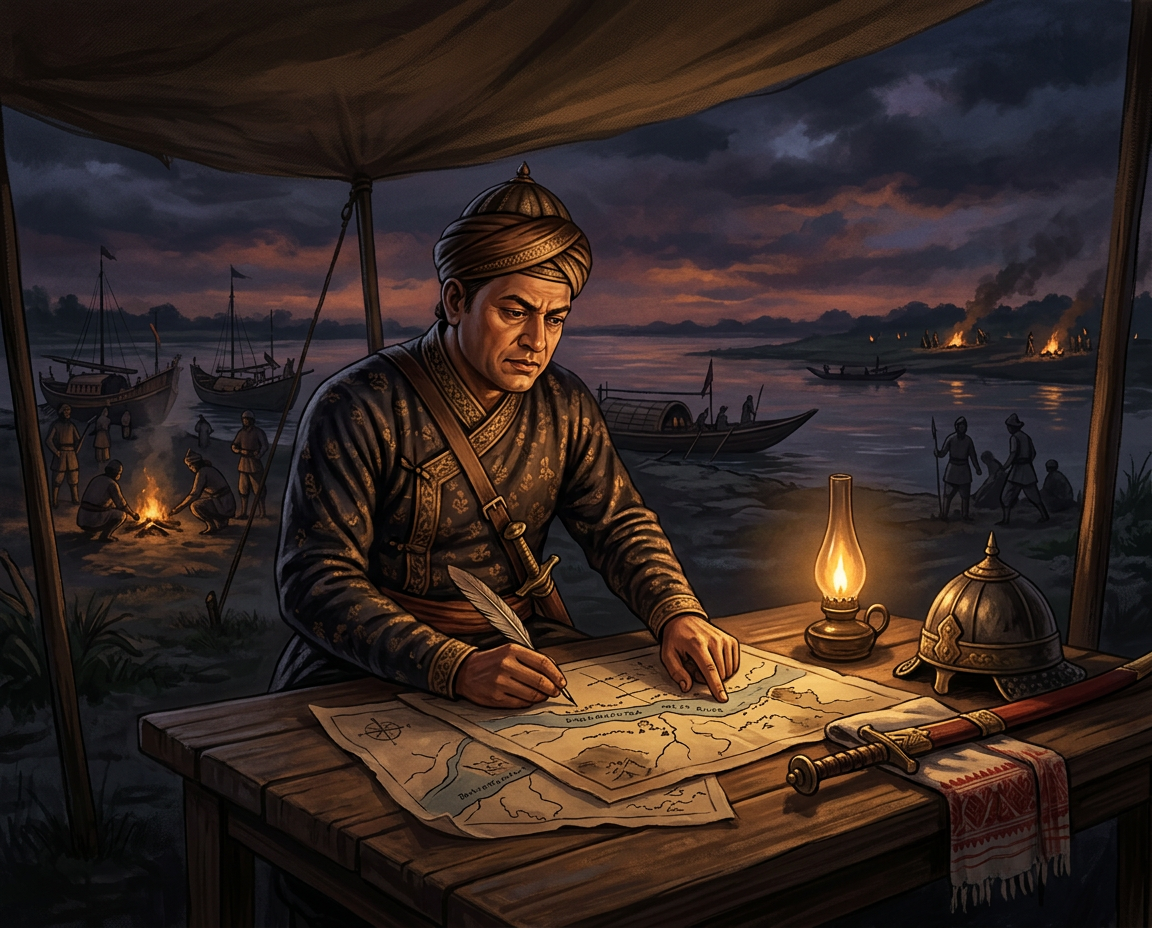
The story of Lachit Barphukan is centered on the Battle of Saraighat (1671), a pivotal naval conflict on the Brahmaputra River. At the time, the Ahom Kingdom faced an existential threat from the Mughal Empire, led by Raja Ram Singh I. Lachit, the Commander-in-Chief (Barphukan), was severely ill during the height of the campaign. Legend dictates that upon finding his maternal uncle neglecting the construction of a strategic earthen wall (the Momai-kota Garh) intended to stop the Mughal advance, Lachit executed him on the spot. His famous declaration—“My uncle is not greater than my motherland”—galvanized the Ahom forces, leading to a miraculous victory against a numerically superior foe and ensuring Assam remained independent of Mughal rule.
The fluorescent glow of the war room was a sickly yellow, mirroring the fever that was baking Lachit from the inside out. He sat hunched over a holotable, its cool surface offering no relief to his burning skin. The holographic projection pulsed with aggressive red lines—the digital footprint of Mughal Solutions encroaching upon the Saraighat sector.
Lachit was the newly appointed COO of Ahom Inc., a whirlwind of innovation brought in to salvage a company stagnant with nepotism and “old guard” complacency. The pressure was a physical weight on his chest. Raja Ram Singh, the CEO of Mughal Solutions, was not just a competitor; he was a corporate warlord. His “Operation Red Fort” was moving with the precision of a hostile takeover meant to erase Ahom Inc. from the map.
As the night wore on, the fever took Lachit deeper into a waking delirium. The hum of the server racks became a rhythmic battle cry; the flicker of the projectors mirrored a storm of arrows. He saw not data points, but enemy formations; not lines of code, but strategic chokepoints. In this fever dream, a voice—his own, yet ancient—screamed from the depths of his subconscious, warning of a fatal weakness. A breach. The unlocked gate.
He jolted awake, drenched in cold sweat. The premonition was too visceral to ignore. Ignoring the protests of his aching joints, he moved through the quiet corridors toward the main data center—the nerve center of their proprietary defense encryption. He arrived to find the heavy security door unfastened. It hung slightly ajar, a silent, silver accusation.
Inside, slumped over the main control console amidst a sea of glowing monitors, was his maternal uncle, the Head of Security. Fast asleep.
The blood that had been racing through Lachit’s veins seemed to freeze. This wasn’t just a security lapse; it was a betrayal of the mission. It was the physical manifestation of the corruption and “family-first” negligence he had been hired to purge. His uncle, a figure of childhood warmth and professional trust, had gambled the livelihoods of thousands for a moment of personal comfort. The fever boiled over, giving way to a clarity that was terrifying in its simplicity.
He didn’t scream. He didn’t shake the man awake to offer an excuse. He reached for the ceremonial letter opener on the desk—an elegant, silver-plated dagger presented to him by the Board of Directors. With a single, fluid motion born of absolute finality, he terminated the threat.
The morning light found him still standing there, the dagger resting on the console, his eyes burning with a cold, unwavering intensity. When the first shift manager entered, he stood frozen, unable to comprehend the grim tableau. Lachit didn’t flinch. He simply looked at the man, his voice a hoarse but steady rasp:
“He endangered the company. My uncle is not greater than my market.”
That single act of ruthless integrity did more than any memo or HR policy ever could. The story spread through the cubicles and boardrooms like wildfire—a legend of a leader who would let nothing, not even blood, stand in the way of the company’s survival.
The corporate culture shifted overnight. The lingering complacency vanished, replaced by a razor-sharp focus. Fear matured into respect, and respect forged an unbreakable discipline. When Mughal Solutions finally launched their full-scale, multi-pronged market assault, Ahom Inc. was no longer a tired corporation. They were a lean, agile fighting force. They outmaneuvered the lumbering giant, exploiting the Mughals’ bureaucratic lag and defending their market share with a ferocity born of that single, decisive moment. The victory was a testament to Lachit’s strategy, but more importantly, it was a reminder: in the face of an existential threat, unwavering discipline is the only true defense.
This short story is a work of fiction based on life experiences.

The Lachit Borphukan Gold Medal is awarded to the best passing out cadet at the National Defence Academy (NDA) in India. Instituted in 1999, it recognizes exceptional leadership, tactical acumen, and bravery, honoring the 17th-century Ahom commander who defeated the Mughal army at the Battle of Saraighat in 1671.
Awarded to the top cadet (Best Cadet) of the passing out course of NDA with a view to inspire dedication and bravery among cadets by highlighting the heroism of Lachit Borphukan.