

Rahul wasn’t just smart; he was hyper-perceptive. He could look at a mountain of data and instantly see the single, golden thread that unlocked its meaning, pulling insights while others were still warming up their keyboards. But this gift was a curse. His mind moved too fast, his truths were too sharp, and he knew they made others uncomfortable—a potent blend of threatened and confused.
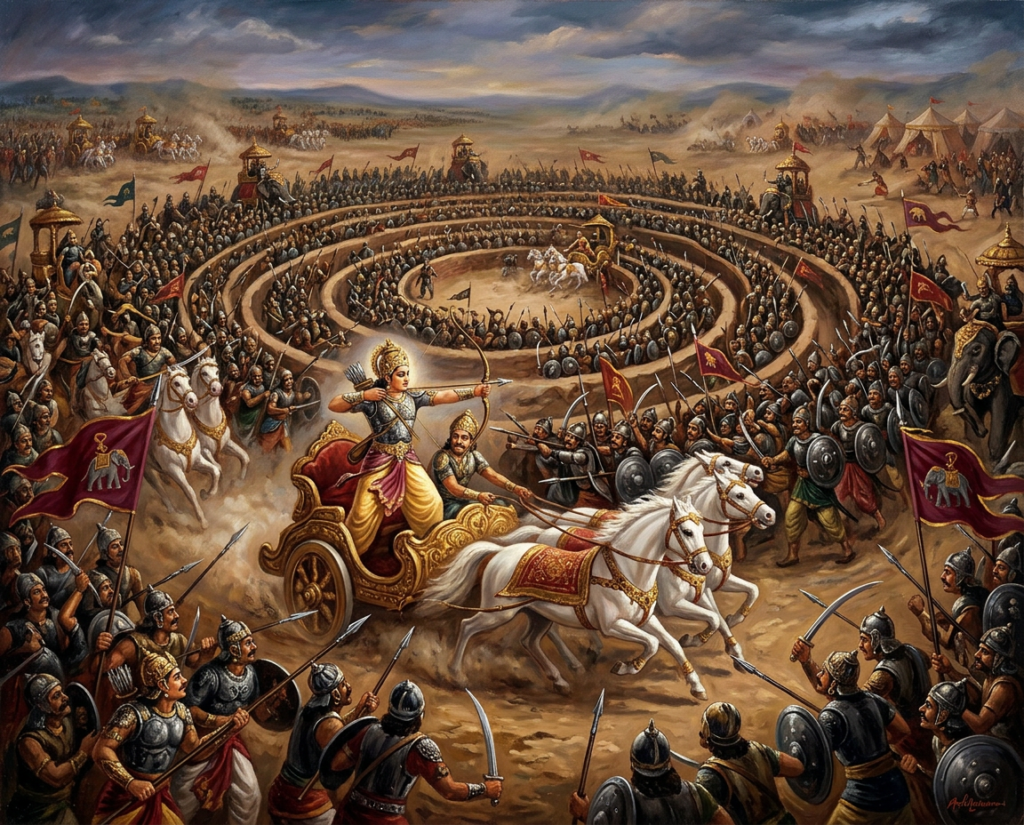
He saw his career path laid out like a colossal, fortified structure: the corporate Chakravyuha.
On one hand was the Moral Imperative—the path of the Modern Abhimanyu. It meant charging into strategic meetings, speaking the clear, unvarnished truth, correcting the five-year-old flawed assumptions, and pushing for the optimal strategic path the data screamed was necessary. He knew he possessed the singular brilliance to enter this complex, data-driven “Chakravyuha,” tearing through years of mediocrity with pure logic.
The risk was fatal. He knew, instinctively, that exposing the deeply embedded flaws of senior leaders would make him a political pariah. He was a novice in the power games. He would face not a single worthy adversary, but a collective ambush, ganged up upon by those who could not compete on intellect. It was a choice of Integrity over Survival.
On the other hand, was the Smart Path—the choice to Avoid the Chakravyuha Altogether. This path involved applying his brilliance only to safe, ancillary projects, where his only competition was the problem itself, not the insecure human ego. He would be intellectually compromised—operating below his capacity to keep the peace—but he would be safe. It was a choice of Survival over Impact.
He shared his dilemma late one evening with Maya, his friend and romantic interest, who worked in social psychology—a field far removed from the cold logic of spreadsheets.
“It’s like the data demands the truth, but the structure demands silence,” Rahul said, his frustration thick in his voice. “I see the right answer so clearly, but I know if I speak it, I’ll be committing professional suicide. It’s Abhimanyu all over again: I can enter the data labyrinth, but I don’t know the politics to exit alive.”
Maya looked at him with a deep, thoughtful gaze. “Rahul,” she began, “you’ve framed this as a choice between being a martyr and being mediocre. That’s a false dilemma. You’re brilliant, not a battering ram.”
“The true path is not to smash the structure, but to influence it,” Maya asserted, leaning forward. “You don’t lack the knowledge to exit; you lack the patience to map the exit. Abhimanyu’s flaw was not knowing the technique; your flaw is wanting the outcome instantly without respecting the people involved. Your truth is a bomb. You can’t just throw it; you have to package it as a gift.”
She laid out her counsel:
- Convert Certainty into Inquiry: “The moment you deliver your insight as a final statement, it becomes an attack. The political savvy you lack is the ability to convert your certainty into a shared inquiry.” She offered him a phrase to memorize: “Instead of saying, ‘The data proves your strategy is wrong,’ you must ask: ‘If we integrate this new data point, how does it challenge our original assumption, and what collective conclusion do we draw?'”
- Sell Adaptation, Not Correction: “Don’t expose a five-year-old mistake. Reveal a five-minute-ago market shift that forces a new direction. Frame your insights not as a correction of their past error, but as a necessary adaptation to a market change, they couldn’t have predicted.” This allows the senior leaders to save face.
- Build Allies, Not Witnesses: “If you charge in alone, they will gang up. If you share your insights privately with a few non-threatened people first, and let them speak the truth with you, you are no longer a target. You are the architect of a movement. Your brilliance should empower others, not paralyze them.”
“Your moral choice isn’t whether to speak the truth, Rahul. It’s how to speak it so that it survives,” Maya concluded, placing her hand gently over his. “You can be the honest hero and the smart survivor, but you have to stop fighting the people and start focusing on the problem.”
Rahul looked at the Chakravyuha again. It was still formidable, but now, he didn’t just see walls; he saw angles, potential allies, and a new strategy for entry and exit. The dilemma was no longer a choice between two bad options, but the complex, subtle work of forging a balanced path where his integrity could coexist with his survival. He had his entry plan; now, thanks to Maya, he had a blueprint.
This short story is a work of fiction based on life experiences.


Excellent story. These are strategy lessons as much as life lessons.
It reminds us that it is not enough to speak the truth; one must speak it in a way that allows the truth to survive and influence decisions.
As always you have used the metaphor of Abhimanu and the Chakravyuha beautifully.
A very good simple short story with a lesson, which smart people learn through experiences- if you can’t compromise on your values , and at the same time, want to survive in adverse situations, there is a way out.