

The fluorescent lights of the Gurugram office hummed above Rohan Verma’s head, mirroring the frantic energy in his chest. As the engineering project manager for ‘Project New Coach Design’ – a revolutionary new passenger coach design – Rohan believed in speed above all else. His mantra was simple: parallel processing. Why do things sequentially when you can tackle them all at once?
Project New Coach Design was a beast of a project. It involved cutting-edge materials science, complex electrical and mechanical engineering, intricate software controls, and a brand-new manufacturing process. Rohan, convinced of his team’s brilliance and driven by an aggressive timeline, had them working on every aspect simultaneously. The materials team was deep in research, the electrical engineers were designing circuits, the software developers were coding algorithms, and the manufacturing team was sketching out layouts and component details – all at the same time.
His lead engineer, Priya, a veteran with a calm demeanor, often voiced her concerns. “Rohan,” she’d say, her voice gentle but firm, “we need to finalize the material specifications before the electrical team can optimize the circuitry. And the software depends heavily on the finalized hardware interfaces. We’re creating dependencies that might bite us later.”
Rohan would wave his hand dismissively. “Priya, we don’t have the luxury of linear progress. We’ll iterate, we’ll adapt. We’re a smart team; we can handle the complexity.” He envisioned a perfectly orchestrated symphony of progress, each team contributing their piece simultaneously to create a magnificent whole.
But the reality was far from harmonious. The materials team kept discovering new promising leads, forcing the engineers to constantly redraw their schematics. The ever-shifting hardware specifications meant the software team was perpetually rewriting code, chasing a moving target. The manufacturing team, lacking finalized designs, was stuck in a limbo of hypotheticals.
Chaos reigned. Meetings turned into blame-fests, progress reports were riddled with caveats, and the project timeline, initially ambitious, was now slipping at an alarming rate. Rohan, buried under a mountain of conflicting updates and unresolved dependencies, felt like he was wrestling a dozen snakes, each slithering in a different direction.
One sweltering afternoon, during a particularly frustrating review meeting, their senior technical advisor, Mr. Kishore, a man known for his insightful analogies, cleared his throat. He looked at the harried faces around the table.
“Rohan,” he began, his voice calm amidst the storm, “imagine you wish to eat a crocodile.”
Rohan frowned, bewildered by the sudden shift in topic.
Mr. Kishore continued, a twinkle in his eye, “A large, tough crocodile. Would you attempt to swallow it whole?” A nervous chuckle rippled through the room.
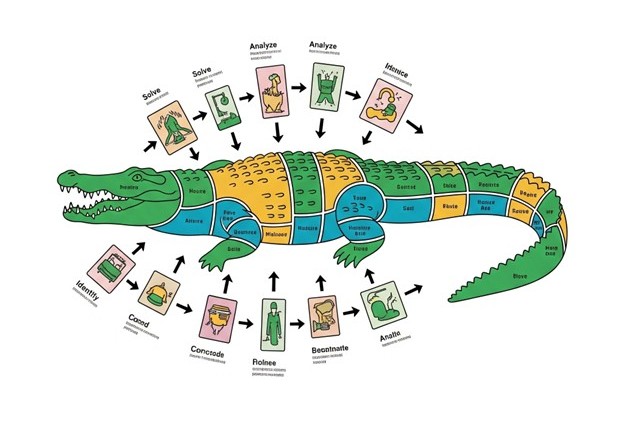
“Of course not,” Mr. Kishore said, answering his own question. “You would first have to cut it into manageable pieces. Then, you would process each piece properly – perhaps marinate some, grill others, ensuring each part is cooked and ready to be consumed. And finally, you would eat these pieces, one at a time. You wouldn’t try to gulp down the entire beast in one go.”
The analogy hung in the air. Rohan, initially confused, slowly felt the weight of its wisdom sink in. Project New Coach Design was their crocodile. He had been so focused on the grand vision, on the speed of parallel execution, that he had overlooked the fundamental need to break down the complex challenge into smaller, manageable components and process each one thoroughly before moving on to the next dependent stage.
He looked at Priya, a sheepish expression on his face. He finally understood her concerns. They hadn’t been making progress; they had been creating a tangled mess of half-finished tasks and unresolved interdependencies.
The next day, Rohan called a different kind of meeting. This time, there were no parallel updates. Instead, they meticulously broke down Project New Coach Design into sequential phases. They prioritized finalizing the core material specifications, then moved on to the electrical design, followed by software development, and finally, the manufacturing process. Each team focused on their current “piece of the crocodile,” ensuring it was perfectly prepared before handing it off to the next stage.
The shift wasn’t immediate. Untangling the existing mess took time and effort. But slowly, methodically, progress began to solidify. The inter-team conflicts subsided as dependencies became clearer. The project timeline, though still delayed, now had a sense of realistic forward momentum.
Rohan learned a crucial lesson: ambition and speed were valuable, but they needed to be tempered with a structured approach. You couldn’t force-feed innovation. Large, complex challenges required a deliberate, step-by-step process. You had to cut the crocodile into pieces, process each piece with care, and eat them one at a time to truly conquer the beast. Project New Coach Design, though it faced its initial stumbles, eventually succeeded, not through a chaotic sprint, but through a series of well-managed, sequential steps.
This short story is a work of fiction based on life experiences.