Mr. Rao had grown very fond of Rahul. He was, quite simply, the sharpest kid he’d seen in years. Rahul could make sense of data at a lightning speed, pulling insights from complex spreadsheets while others were still sipping their morning coffee. But he was just too sharp. Most people found it difficult to grasp what he was saying, and Mr. Rao worried it would become a problem.
Very early one morning, before the rest of the team had arrived, Mr. Rao called Rahul into his office. “Rahul,” he began, his voice low and serious, “you have to mask your intelligence, otherwise they will go after you.” Rahul’s brow furrowed in confusion. “Go after me? Sir, I don’t understand.”
“They will not only target you individually but also gang up in myriad ways,” Mr. Rao explained. “No senior likes to have a junior on their team who can easily outshine them in almost every meeting. They will wait for you to make a single mistake and then pounce on you as a pack of wild dogs.” He leaned forward, his voice softening. “And then there are the seniors on the fast track, the ones making all kinds of compromises. They’re already committed to certain strategic thrusts, too deeply embedded in the labyrinth to change course. They will not tolerate a deviant, sharp kid telling them that they took a wrong path five years ago.”
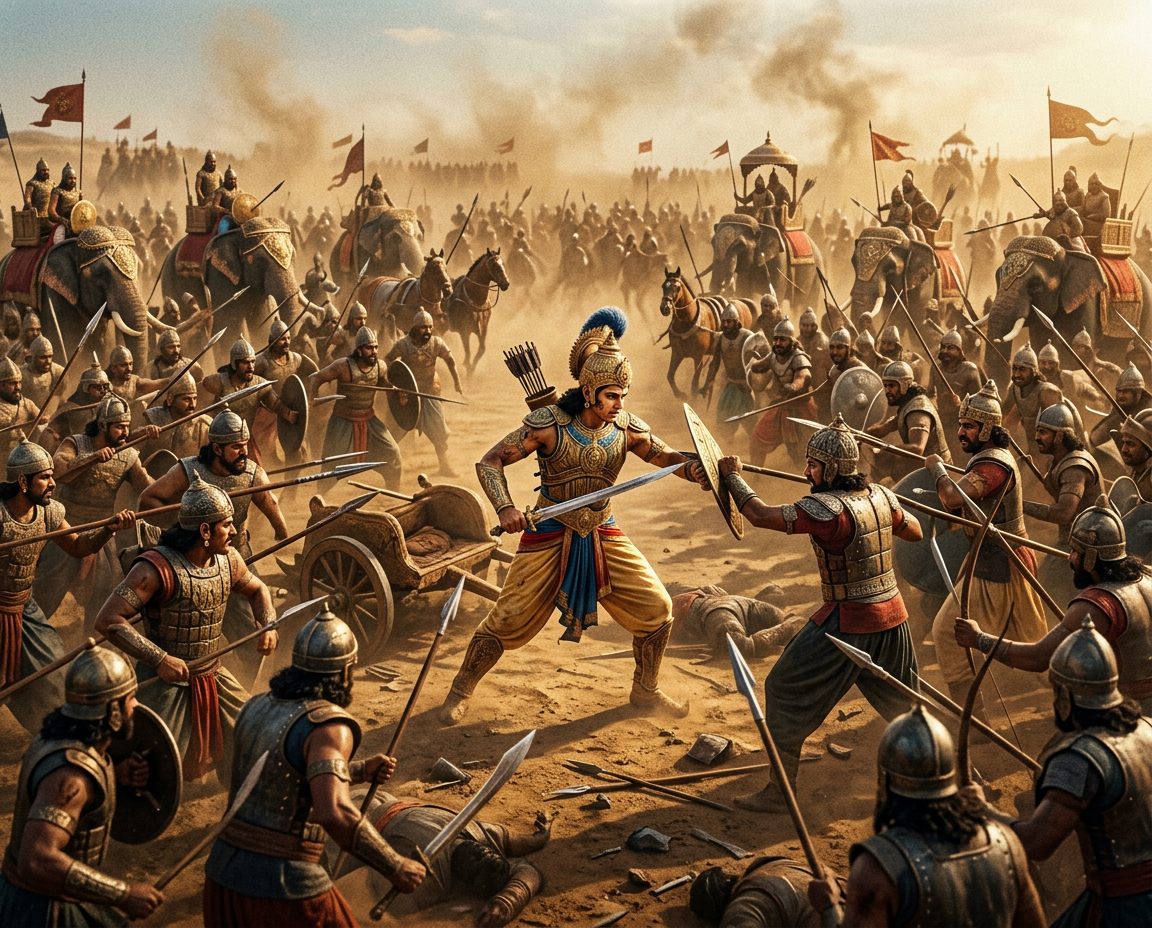
Mr. Rao’s words hung heavy in the air, a modern-day echo of an ancient warning. He was talking about corporate survival, but Rahul couldn’t help but think of the mythological hero Abhimanyu. Abhimanyu, an unmatched warrior, could enter the formidable Chakravyuha but lacked the knowledge to exit. The Kauravas, unable to defeat him individually, ganged up and attacked him collectively. Similarly, Rahul, with his singular brilliance, could easily enter the complex “Chakravyuha” of data and strategy, but his lack of political savvy in this new world left him vulnerable. His superior skill, like Abhimanyu’s, made him a target for those who could not compete on equal terms. They would not face him one-on-one; they would plot and gang up to bring him down.
Mr. Rao’s expression grew pensive. “Maybe I was like you. Maybe I’m hoping that you will not be as foolish and ignorant as I was. Maybe ‘wisdom’ lies in learning from the experiences of others. I hope you will find a meaning in what I’m trying to tell you.” Rahul was totally confused by now. This was new to him. He was an animal on the prowl, and he was enjoying his “hunts” on a day-to-day basis. What a joy it was to present a new way of looking at data and pointing out “stupid mistakes” others were making, especially in a large meeting where everybody was present! He was just trying to be fairly competitive, after all! And enjoying it!
Did he really have to take a long-term view? Did he really have to mask his intelligence? The questions lingered in his mind as he left Mr. Rao’s office, casting a shadow over the thrill of the hunt he so deeply enjoyed.
This story explores the difficult choice between being your true, brilliant self or adapting to the unwritten rules of corporate survival. Do you think Mr. Rao’s advice is a necessary evil, or is it a sign of a flawed system? Should today’s Abhimanyu avoid entering the Chakravyuha?
Note: It takes a type of “intelligence” or “maturity” to survive the corporate world. Those lacking Get hit. Those who learn, Thrive. However, the corporate body would suffer if it continues to hit or trip it’s best and brightest. Did Abhimanyu weaken the Kaurava Army by entering the Chakravyuha? If so, would his sacrifice for the be acceptable?
This short story is a work of fiction based on life experiences.