
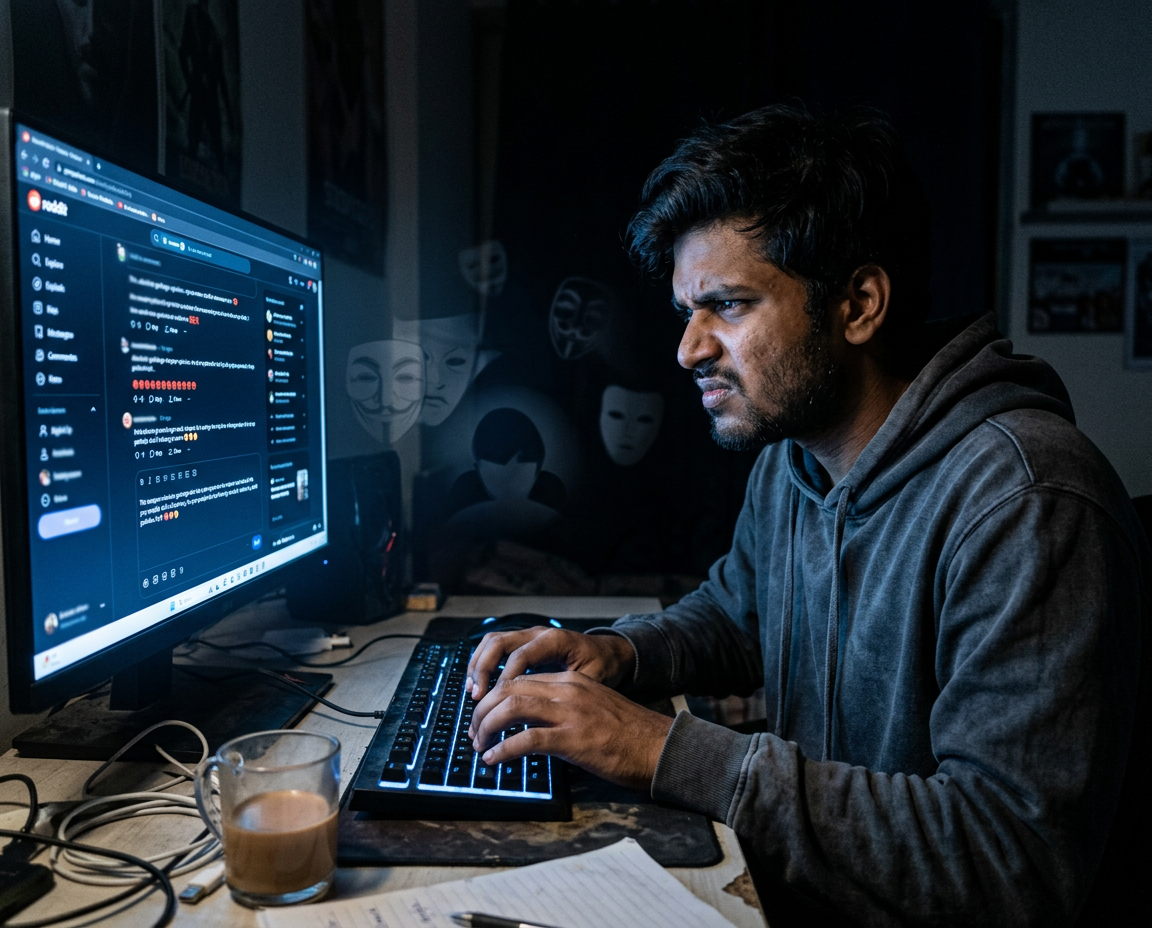
The cursor blinked on the blank comment box, a tiny, impatient eye staring back at Lalit. He had been a regular on this political forum for years, a ghost in the machine who found a twisted comfort in the anonymity it provided.
In the real world, Lalit was a mild-mannered librarian, a man who spoke in hushed tones and flinched at loud noises. His interactions were a series of polite nods and hesitant smiles.
But here, in this digital arena, he was a gladiator, a warrior of words.
He read the post again, a passionate, well-reasoned argument from a user named ‘Verit’. It was an opinion he vehemently disagreed with, and a familiar heat began to simmer in his chest. In the past, he might have simply moved on, or perhaps even engaged in a civil debate.
But not tonight. Tonight, the frustrations of his day – a passive-aggressive colleague, a condescending patron, the general feeling of being overlooked – had coalesced into a potent brew of resentment.
His fingers hovered over the keyboard. He thought of Verit, a person he had never met, whose face he had never seen. There was no risk of an angry glare, no fear of a raised voice, no chance of witnessing the hurt in their eyes.
The digital “distance” was a shield, a buffer between his rage and its target. He could be as cruel as he wanted, and the consequences would be a few angry replies, a temporary ban at worst. The human cost was invisible to him.
So he began to type. The words flowed easily, each one a sharp stone thrown from behind his fortress of anonymity. He used insults he would never dare utter in person, made generalizations he knew were unfair. He felt a surge of power, a fleeting sense of control over a world that often felt so out of his grasp. The words were not just an attack on Verit; they were a cathartic release, a scream into the void.
When he was done, he hit ‘enter’. The comment disappeared into the endless stream of online discourse, just another drop of vitriol in a digital ocean. He leaned back, the initial rush fading, replaced by a hollow emptiness. He knew he had been cruel, but the knowledge didn’t sting. It was a distant, theoretical guilt. The absence of a real, breathing person on the other end of his attack made it feel like a game, a sterile exercise in cruelty.
Meanwhile, a thousand miles away, a woman named Leena – the real person behind the username ‘Verit’ – read his comment. She felt a familiar jolt of pain, a deep, personal sting. The words weren’t just text on a screen; they were an assault on her beliefs, her character, her very humanity. She had been on the receiving end of such comments before, but they never got easier. Each one was a tiny cut, a reminder of the ugly side of the world. She didn’t know the face behind the cruelty, and in a way, that made it worse. She couldn’t reason with him, couldn’t appeal to his sense of empathy. He was a faceless monster, a ghost in the machine.
Back in his quiet apartment, Lalit was already scrolling for his next target. He didn’t think about Leena, didn’t consider the human impact of his actions. The screen was a mirror, reflecting only his own anger, his own frustration. He was a bully with a keyboard, a coward with a comment box, a man who found it easier to be a monster when he didn’t have to look his victims in the eye. The distance was his license, the anonymity his weapon, and in the cold, digital world, he was free to be the person he was too afraid to be in real life.
This short story is a work of fiction based on life experiences.


You have got the nail on the head. Too many people going to virtual war regularly, hidden behind their anonymous personae. The most unexpected consequence of the ability to have a personalized conversation with almost anyone on the planet.
This is a very insightful article. You’ve made some amazing observations about online behavior! It’s alarming how online cruelty is no longer just limited to strangers; it has started to creep into our interactions with acquaintances we aren’t particularly close to.
This trend poses a grave threat to our social fiber.
Very true. How the digital media gives one a perceived sense of anonymity and changes his/her behaviour is very well described here! I am sure that it is phenomenon being researched.