
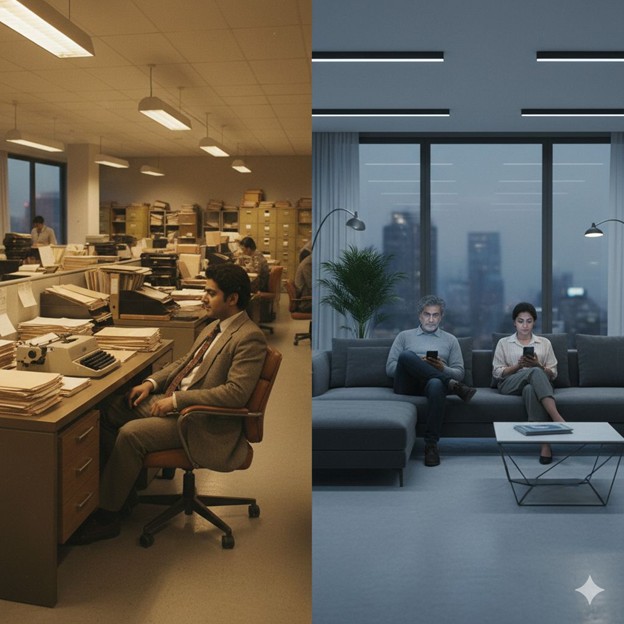
9 AM, 1985. Sameer, a young executive, sat in his old leather chair. The room buzzed with the clatter of typewriters and the low hum of a giant server. His desk was buried under stacks of paper, and a red pen was in his hand, correcting errors in a budget report. Across the open-plan office, a young, bubbly woman named Priya was meticulously filing documents. A shy smile passed between them whenever Sameer’s gaze fell on her. He wanted to ask her out for dinner, but the thought of calling her from the single office phone line shared by the entire department felt terrifying. The rigid protocol of the corporate world felt like an impenetrable wall.
Sameer was working on a major deal, but a crucial piece of data was missing from a file. He had been searching for it for an hour, his patience wearing thin with every useless page he turned. He told his assistant, “Go, find this file from the old records room. I need this report by 1 PM.” This task would take hours, and the time spent hunting for data had put the entire deal at risk. Sameer believed that if there were technology in the future that could do all this with the press of a button, life would be so much easier. He was convinced that technology would eliminate all of humanity’s problems, whether they were missed connections or logical nightmares.
Almost 40 years later, 2025. Sameer was the CEO of a huge multinational corporation. His office was a minimalist expanse of glass and polished steel. On the screen in front of him, the fluctuations of global markets were visible in real-time. He tapped his watch, and his voice-based assistant immediately generated a report, flagging a potential threat to a major project. A new algorithm had predicted that a supplier in Europe was facing a cyber-attack, which could delay their shipment. Sameer immediately tapped a button on his tablet, and a virtual meeting with his teams across four cities worldwide began.
Sameer quickly assessed the situation and told his team to find an alternative supplier and fix the problem. For a moment, he felt how fortunate he was to have such advanced technology that could save him from a crisis that would have taken weeks to resolve in the ’80s. He told his assistant, “Handle this.” But just as he was about to end the meeting, his head of technology informed him, “Sir, there was a bug in the algorithm. The data used was old because a data entry operator had forgotten to update the report last night.”
Sameer’s eyes widened. He stared at his screen in disbelief. In a world where artificial intelligence and machine learning control everything, a simple human error—a lapse of mind—had messed everything up.
That evening, Sameer returned to a quiet home. He found his wife, Priya, sitting on the sofa, scrolling through her social media feed, while he, on the other side, was still checking work messages on his phone. They were in the same room, but thousands of digital walls were separating them. They ate dinner, but their conversation was interrupted by the sounds of notifications and the slow glow of their screens from under the table. The silence between them felt heavier than the hours he’d spent waiting for a call back in the ’80s.
Priya looked up from her phone and sighed. “Remember when we used to write letters to each other on business trips? The wait for a reply… that was something else.”
Sameer put down his phone. A glimpse of the past came into his mind. He remembered the shy smile, the shared landline phone, and the courage it took just to say hello. He realized that while the means of communication had dramatically changed, the core struggle remained the same: to find a way to truly connect with the person you love, despite all the distractions. In 1985, it was old technology that delayed the connection. In 2025, it was the endless flood of information that drowned it out.
Sameer reached across the table and held Priya’s hand. He had spent his life believing that technology would solve all of humanity’s problems, but he was finally beginning to understand that some of life’s most beautiful and most challenging moments would always depend on our imperfect, complicated, and wonderfully human choices and preferences. Just as a small mistake by a data entry operator affected a multi-million dollar deal, similarly, the courage to make a phone call, the restlessness of writing a letter, or a small gesture of holding hands even in today’s noise, these are all moments that truly make life special.
Truly, the more things change, the more they remain the same.
This short story is a work of fiction based on life experiences.
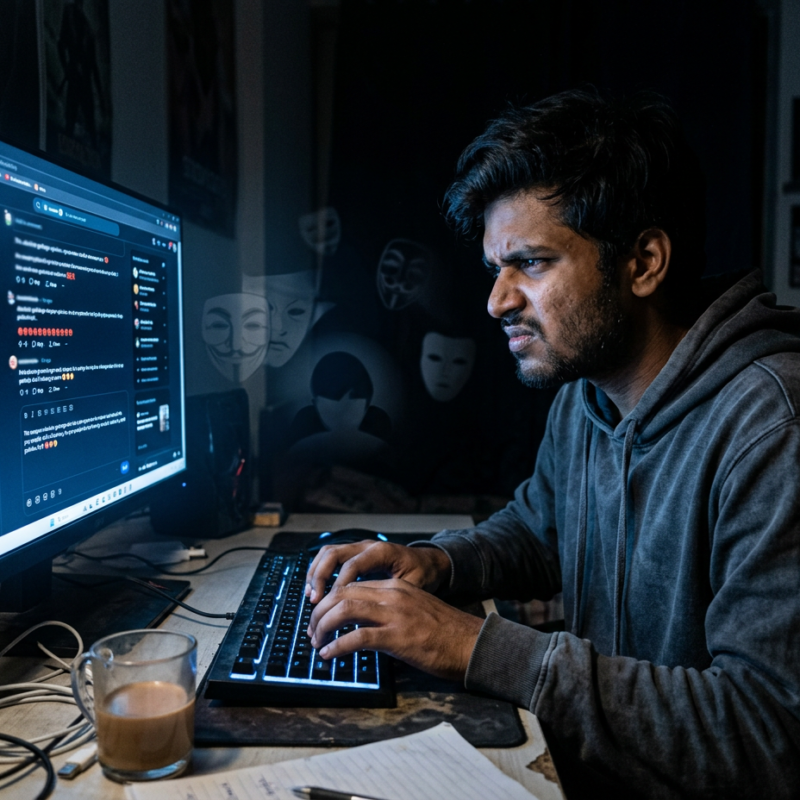
I find this piece to be a poignant, well-structured reflection on the evolution of modern life. Given your background, it is no surprise that the story excels in its focus on systems, processes, and the inevitable “friction” that exists between human intent and technological capability.
Sir, after reading this short story, I have come to know of your talent for writing in the romantic genre, apart from your work on strategy and technology.
The biggest takeaway for me was that technology is merely an amplifier and not a replacement for human connection. The ending, where Sameer simply reaches out and holds Priya’s hand, was truly poignant and powerful.
Thank you for this beautiful piece Sir. Looking forward to reading more of your posts.
So true. Technology is highly overrated, primarily because we fail to understand that it is just a facilitator. Infact, the digital world has erected more barriers than removed them. So well articulated