
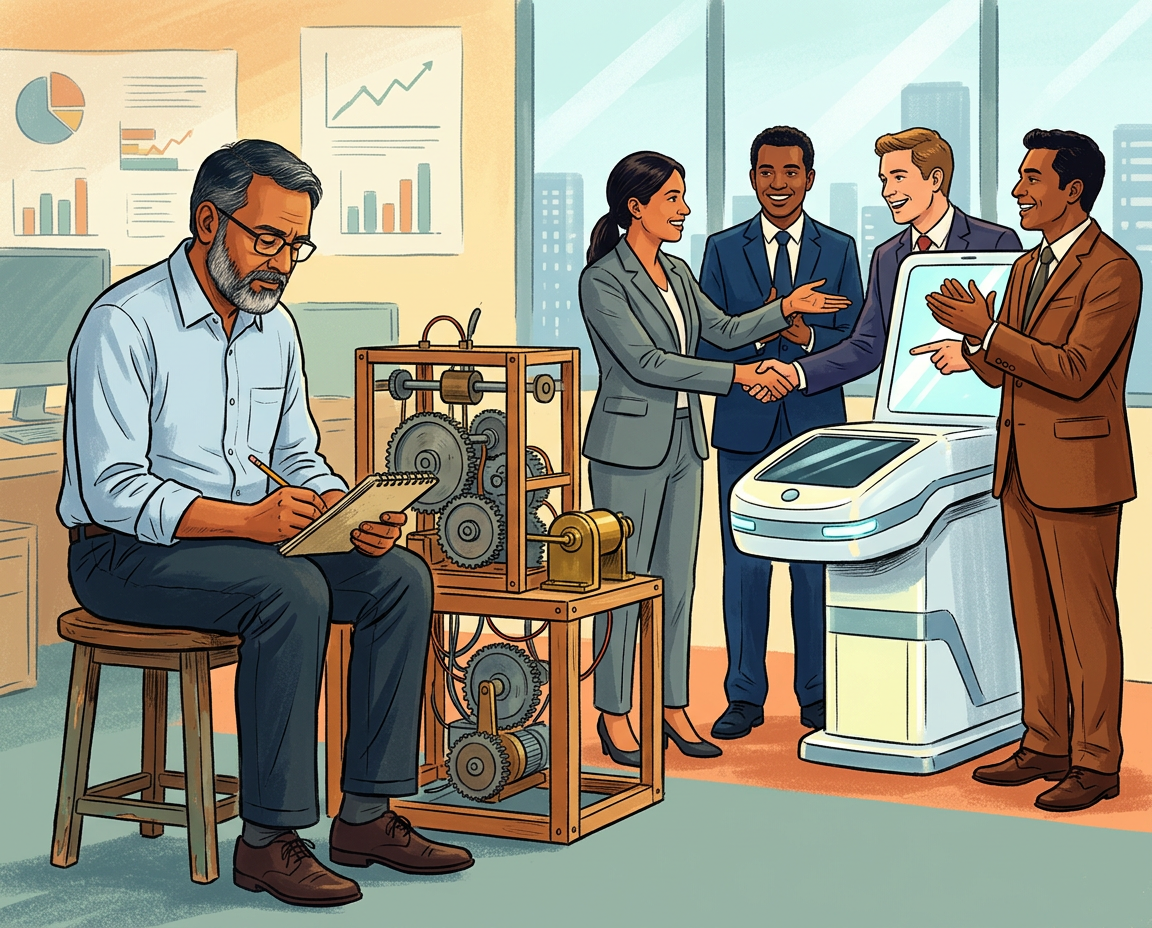
The prototype of the Quantum Resonator hummed to life, a low, ethereal thrum that filled the lab. Dr. Amit Sinha, head of R&D at OmniTech, watched the display with a mix of exhaustion and triumph. It was a moment he had envisioned for years, a breakthrough that could revolutionize data processing. He was a scientist, a dreamer, and he knew he had just laid the foundation for something monumental.
The next morning, Amit’s office was a whirlwind of activity. “The resonant frequency is unstable,” he told his lead engineer, Maya Sharma. “We need a way to dampen the quantum noise without affecting the data stream.”
Maya nodded, already sketching out schematics. She called in a team of junior engineers. “We’re building a new chassis,” she explained, “something that can house a passive damping system. Think minimal, think elegant.”
The chassis team, led by a young prodigy named Liam, went to work. They argued over materials, debated thermal dynamics, and finally settled on a new polymer-steel alloy.
It was Liam’s suggestion, a material he had been experimenting with for a personal project. He didn’t know the exact application, but he knew it would be perfect for what they needed.
A few days later, a grizzled manufacturing veteran, known only as “Mohan,” saw the prototype on his shop floor. He shook his head. “That’s a production nightmare,” he grumbled. “One bad weld and the whole thing fails.”
Mohan spent two weeks redesigning the assembly process, simplifying the welds, and creating new jigs to ensure every unit would be flawless. He didn’t have a PhD, but he had a lifetime of knowing what works and what doesn’t.
Meanwhile, the marketing department got wind of the project. Sara, the head of marketing, saw the Quantum Resonator as more than just a piece of technology. She saw it as a story. She began crafting a narrative about a breakthrough device that would change the world, a device that was the culmination of OmniTech’s vision and dedication.
At the product launch, the CEO stood on a stage, a sleek, polished Quantum Resonator in his hands. He spoke of innovation, of OmniTech’s relentless pursuit of the future, and of a team that had defied the odds. The media headlines were glowing: “OmniTech’s New Resonator a Game-Changer,” “The Future of Computing is Here.”
That evening, Amit sat in his quiet lab, looking at the prototype. The Quantum Resonator was the same machine he had birthed, but it was also different. It had Maya’s elegant chassis, Liam’s innovative alloy, Mohan’s robust assembly, and Sara’s compelling story.
He had created the core idea, the single most important part, but it was the collective genius of many hands and many minds that had transformed his breakthrough into a marketable, successful product.
The Aftermath
The praise was immediate and widespread. As the accolades poured in, the narrative began to shift. The CEO, in interviews, spoke less of the team and more of his “visionary leadership” that had fostered such an environment of innovation. Sara, the marketing head, appeared on business channels, framing the success as a result of her “strategic foresight” in branding the product before it was even finished.
Maya, the lead engineer, was quick to point out in an all-hands meeting how “the structural integrity of the chassis was the true key to its stability,” implying that her contribution was the most critical. Liam, the young engineer, began presenting his alloy research at industry conferences, with the title slide for his presentation proudly declaring his work “the genesis of the Quantum Resonator.” Even Mohan, the old manufacturing veteran, was heard telling his team that “without my re-engineering, this thing would’ve been a hunk of junk.”
Amit watched it all unfold from his lab. The core idea, the one he had spent sleepless nights dreaming about, was now a footnote in a chorus of self-congratulations. He had given birth to a child of pure science, but now, everyone wanted to be its father. It was a bitter lesson. He realized that while the success of the Quantum Resonator had many fathers, he was the only one who seemed to remember its lonely birth.
This short story is a work of fiction based on life experiences.



Very real like. . It is a bitter truth that typically represents an ecosystem which generates more stories than innovations
But what the story did not tell is that most peaceful sleep that product launch day would have been that of Amit , in all probability . If that were not the case, he would probably have been in other secondary teams
Beautifully penned . The reality of today’s world ! Everyone tries to take the credit in this rat race and the actual father of the idea is left behind !