
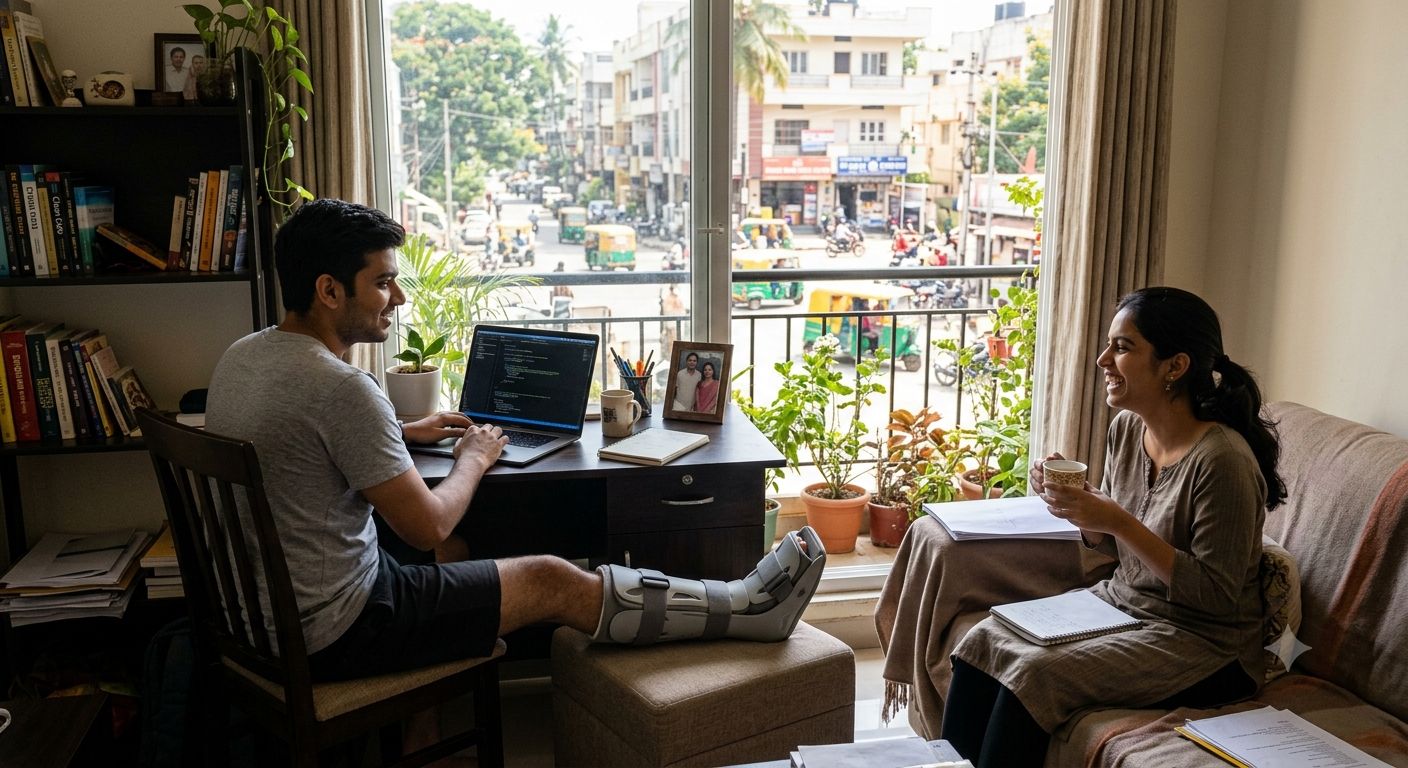
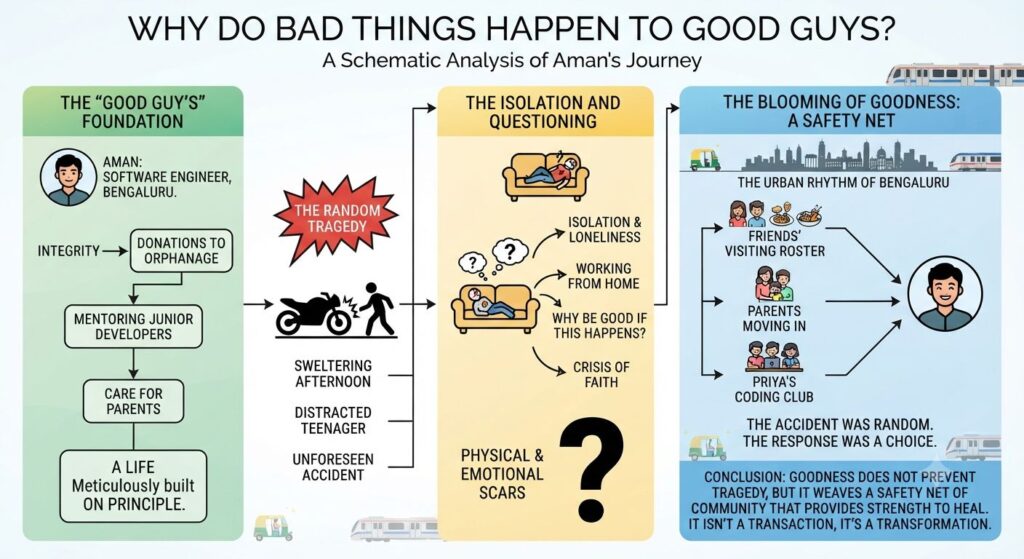
Aman lived a life meticulously built on principle. A software engineer in Bengaluru, he was known for his integrity, his quiet donations to a local orphanage, and the patient way he explained complex code to junior developers. He never cheated on his taxes, always gave up his seat on the metro, and treated his parents with a reverence that was becoming rare. He was, to his colleagues and friends, the quintessential “good guy.”
One sweltering afternoon, a motorcycle, driven by a distracted teenager, swerved onto the pavement and collided with Aman, who was on his way to buy lunch. The impact shattered his leg, and the medical bills, though covered by insurance, left him with a physical and emotional scar. The accident forced him to work from home, a lonely existence far from the camaraderie of his office. He began to question everything. What was the point of being good, of doing the right thing, if a random act of carelessness could dismantle his life?
But in the quiet isolation of his apartment, the urban rhythm of Bengaluru continued. His friends, hearing of the accident, started a weekly roster. One would bring him home-cooked biryani, another would just sit and talk, sharing office gossip. His parents, who lived in a different city, moved in temporarily to take care of him. The junior developer he had mentored, a young woman named Priya, started a coding club for underprivileged kids in his name, teaching them the same principles of hard work and ethics that Aman had taught her.
Aman’s recovery was slow, but it was not lonely. He realized that the accident, while an undeniable tragedy, had not happened to him in a vacuum. His goodness had created a network of people who, in his time of need, had woven a safety net of love and support.
The accident didn’t happen because he was good; it was a random, senseless event. But it was the goodness he had sown throughout his life that had bloomed in the aftermath, providing him with the strength and companionship he needed to heal. The world hadn’t rewarded his goodness with a perfect life, but it had equipped him with the love of a community to face its imperfections.
This short story is a work of fiction based on life experiences.

“A beautiful reminder that kindness always returns—often when we need it most.”
No one has any entitlement in life, be it good health, love from family, friends, not even life itself. The concept of entitlement is man-made. Whatever is there is free dole. 🙁
Life and mathematics are two very different things. In life, 2+2 is sometimes 3 and sometimes it’s 5. Being happy in life is often accepting things the way they are.
It was good content, Sir. Reading different perspectives from different people helps us take informed decisions in life.
Wonderful!
So very insightful. You can’t control most events. But you can control how you respond to those events. Courage in the face of adversity is truly the stuff of life.
There is a saying “Jo hota hai ache ke liye hota hai” and we don’t have much control over what will happen in life.
Even though more often than not I have seen bad things happening to good people just because they were good, such stories are a strong reminder that goodness still matters, and that some of life’s most valuable things lie beyond any price tag.