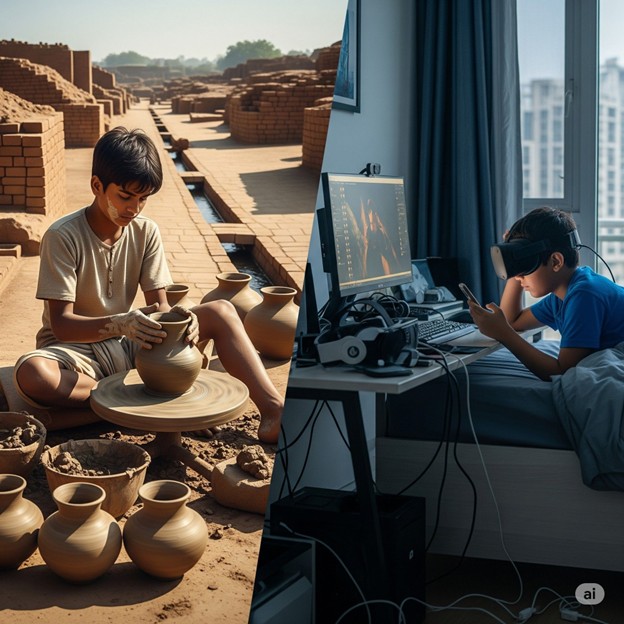
In the bustling city of Mohenjo-Daro, circa 2500 BCE, lived a 14-year-old boy named Vihan. His days were a rhythmic dance of sun and soil. His world’s greatest technologies were the kiln his father used to fire terracotta pots and the well-planned grid of his city’s streets, complete with an advanced drainage system that carried away waste.
Vihan’s education wasn’t found in a book but in the dust of the streets and the feel of clay in his hands. He learned to work the potter’s wheel, shaping pots with a practiced hand, his father’s lessons echoing in his ears. He learned to identify the changing seasons by the stars and the height of the sun, crucial knowledge for a city that relied on the fertile banks of the Indus River. His communication was face-to-face, his stories told around the evening fire, his world limited to the sounds and smells of his own vibrant city. The only formal writing he saw was the script on seals used for trade, a mystery to most. Vihan’s learning was communal, tangible, and passed down through generations, his survival directly tied to mastering these skills.
Four thousand five hundred years later, in the sprawling, digital metropolis of Bengaluru, a boy named Arjun woke to the gentle glow of a smartphone. His world was not of clay and soil, but of code and fiber optics. His education took place not in a potter’s workshop, but on a 15-inch screen. He spent his afternoons in a virtual reality lab, a technological marvel that let him explore the inner workings of a human heart.
When a question arose, he didn’t ask an elder; he simply typed it into a search engine, and a universe of information appeared in an instant. His friendships were maintained through messages and video calls, bridging continents with a few taps. His world was global and instant. He learned to write not in clay, but in Python and JavaScript, creating programs that could solve complex puzzles. The “technology” of his time was a tool for endless discovery, a gateway to a life his ancestors could never have imagined.
While Vihan’s life was shaped by the robust yet simple technologies that held his community together, Arjun’s was defined by the complex, ever-evolving technology that connected him to the world.
Both boys’ lives were testaments to how human innovation, whether a finely-tuned drainage system or a network of global servers, fundamentally dictates how we learn, how we live, and how we understand the world around us.
This short story is a work of fiction based on life experiences.