

The glass-walled cafe in Indiranagar hummed with the ambient noise of Bangalore—a relentless metronome of espresso machines, clacking MacBooks, and earnest young founders pitching to invisible venture capitalists.
Aaditya and Raghav sat across a table, surrounded by loose sketches, half-empty mugs of filter coffee, and digital tablets glowing with architectural schematics. They had just incorporated AeroBrake Dynamics, a deep-tech startup sitting at the volatile intersection of heavy transportation systems and software.
For three hours, they had been going in circles.
“We are missing the axis entirely, Raghav,” Aaditya said, rubbing his temples. He tapped the glass of his tablet, which displayed a simulation of a high-speed train braking algorithm integrated with avionics telemetry. “Look at what happened with the legacy rail component suppliers in Delhi and Kolkata last decade. They suffered from textbook Marketing Myopia. They thought they were just manufacturing mechanical brakes for diesel locomotives. When the modern rolling stock rollout came in, they were so blind, staring only at their existing orders, that they became obsolete overnight. I refuse to let us fall into that trap. We must look at the macro future.”
Raghav leaned back, blowing on his coffee. “I agree with the danger, Aaditya, but look out that window. This is Bangalore. We are sitting in the epicenter of the AI and information technology explosion. The opposite trap is just as lethal, and frankly, much more seductive. It’s strategic hyperopia.”
“Hyperopia?” Aaditya frowned.
“Farsightedness,” Raghav replied, leaning forward. “The danger of staring so hard at the 2035 horizon—hallucinating fully autonomous, quantum-computed, AI-driven hyperloop networks and interplanetary transit grids—that we completely ignore the cash-flow bleeding out of our bank account this Tuesday. Remember what happened to those flashy mobility startups last year? They raised millions on grandiose slide decks about ‘reinventing the future of mobility,’ but their unit economics were broken, their hardware interfaces didn’t talk to legacy systems, and they went bankrupt before building a working prototype. They tripped over their own shoelaces while staring at the stars.”
Aaditya fell silent, recognizing the trap. In Bangalore, it was agonizingly easy to get intoxicated by infinite possibilities. Every incubator meetup preached “moonshots,” “paradigm shifts,” and “exponential disruption.”
“So how do we draw the line?” Aaditya asked quietly. “How do we map our growth trajectory without falling off either edge of the cliff—neither suffocating in myopic routine nor hallucinating in hyperopic abstraction?”
Raghav pulled a fresh napkin across the table and picked up a black marker. He drew a vertical line, dividing the page into three columns representing the distinct ecosystems they were trying to bridge: Information Technology, Complex Rail Systems, and Space Technologies.
“Let’s ground it,” Raghav said. “Let’s look at all three domains right here in our backyard and figure out where the near-sighted trap and the far-sighted mirage live—and how we strike a balance.”
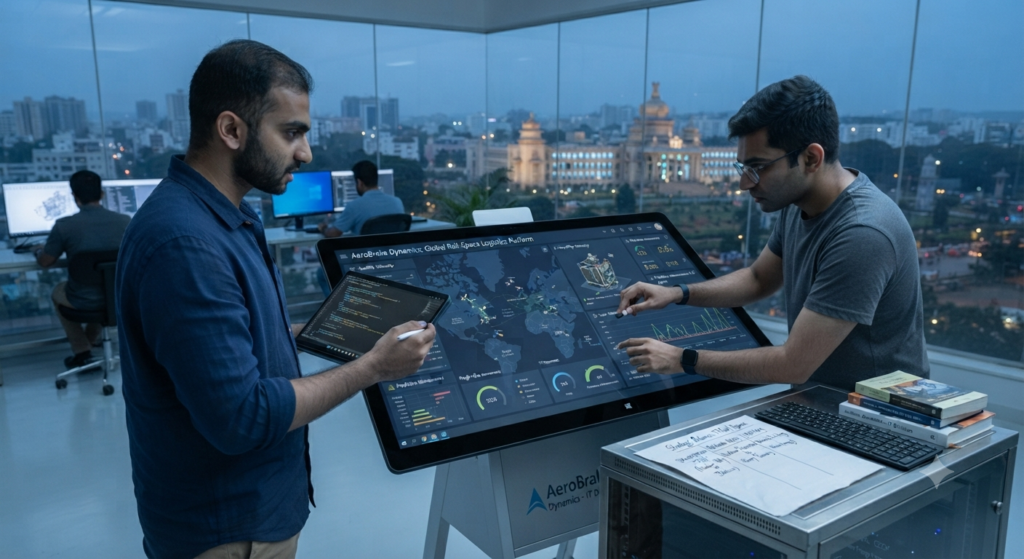
1. The Information Technology Ecosystem: Data vs. Delusion
“Start with the software layer,” Raghav began, tapping the left column. “The myopic trap here is building software features for a client who won’t even exist in two years. It’s tweaking legacy code just because the current customer pays for maintenance. You stay trapped in the immediate transaction.”
“And the hyperopic trap?” Aaditya chimed in. “Building an over-engineered, self-learning, multi-modal LLM agent platform for space-rail logistics when our first customer just needs a reliable, low-latency API to track vibration telemetry on a freight bogie.”
“Precisely,” Raghav nodded. “The strategic balance in IT is modular agility. We use modern cloud architectures and edge computing, but we tie every single sprint directly to an immediate, painful operational bottleneck that a rail operator or aerospace vendor is facing today. We let the software solve the near-term friction while keeping the code base modular enough to scale when the infrastructure catches up.”
2. Complex Products and Systems (CoPS): The Railway Sector
Aaditya took the marker, his eyes lighting up with his deep domain background in heavy engineering. He pointed to the middle column.
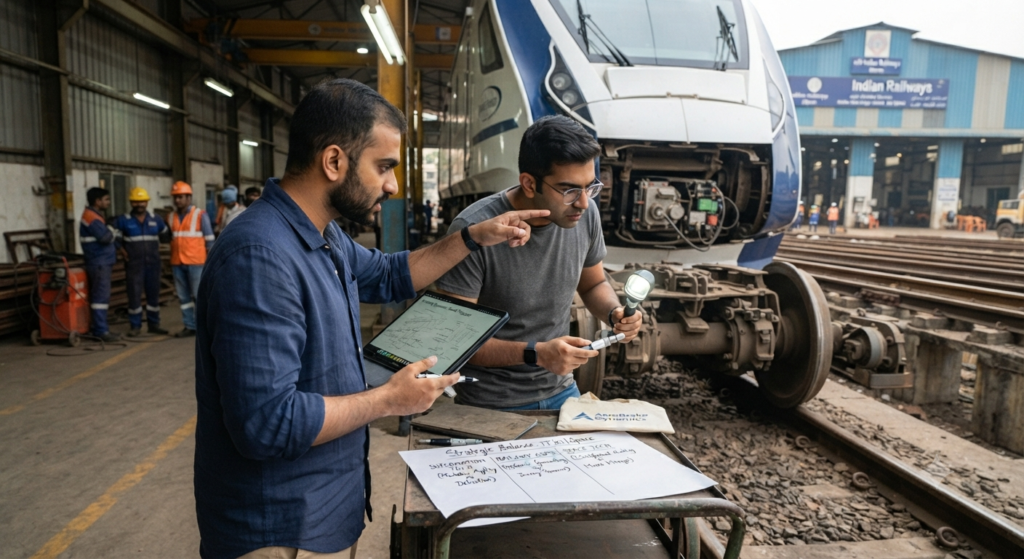
“Now let’s look at the railway sector—the world of Complex Products and Systems (CoPS), where lifecycles span decades,” Aaditya said. “Here, Marketing Myopia is fatal. If a signaling or braking subsystem supplier thinks they are just an ancillary mechanical vendor to a regional railway zone, they will miss the entire digital transformation of train control systems, like the indigenous Kavach anti-collision rollout. They will optimize the old mechanical part until the factory closes.”
“But the reverse—hyperopia—is equally dangerous in heavy engineering,” Raghav warned. “That’s the ‘Ivory Tower’ syndrome. Designing a futuristic, maglev-inspired suspension system on CAD that looks breathtaking, without factoring in the gritty, non-linear realities of Indian gauge tracks, dust, thermal expansion, and the immediate manufacturing tolerances of our partners in Gurgaon or Jamshedpur.”
“So, the balance,” Aaditya said, tracing a line across the paper, “is systemic grounding. We respect the long gestation period of heavy rail infrastructure—designing for a 30-year operational lifecycle—but we validate every sub-assembly through rigorous, localized prototyping right now. We don’t wait for a futuristic transit utopian dream to test whether our braking actuators can handle a dusty monsoon track in North Bengal.”
3. Space Technologies: Launchpads vs. Ground Realities
Raghav drew a final boundary on the right. “And what about our exploratory talks with aerospace components and avionics?”
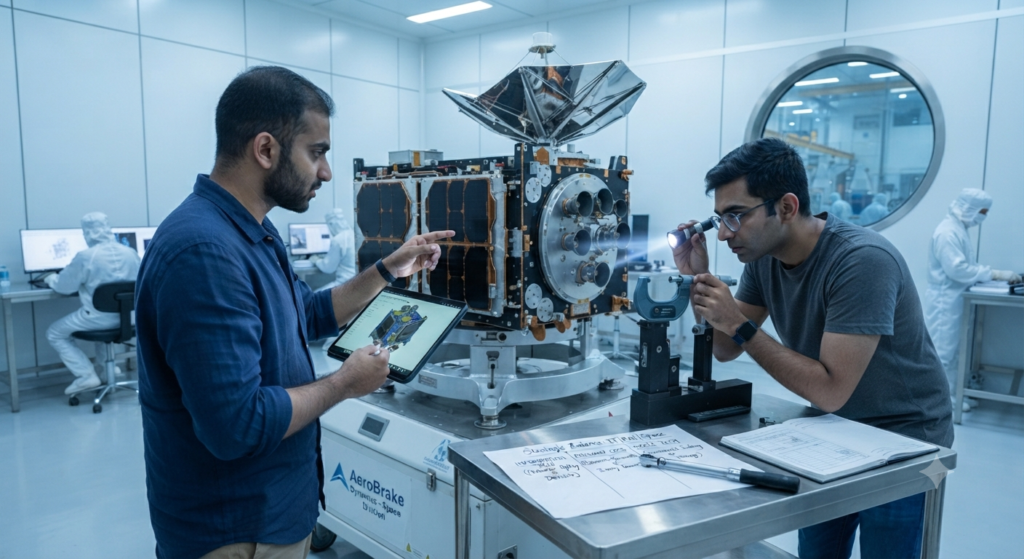
“Ah, the space sector is the ultimate playground for strategic hyperopia,” Aaditya smiled wryly. “It’s easy to get seduced by interstellar colonization narratives, asteroid mining, and deep-space telemetry. Founders start building components for Mars missions when they haven’t secured a single commercial contract for low-Earth orbit satellite stabilization.”
“Yet, myopia there means treating space tech like a traditional localized manufacturing job, ignoring the exponential shifts happening in commercial launch economics,” Raghav added.
“The balance here,” Aaditya concluded, “is disciplined scaling. We anchor our immediate revenue to mundane, high-demand terrestrial and near-Earth applications—like robust inertial measurement units for defense or commercial launch vehicles—while quietly building the R&D muscle for advanced aerospace navigation. We keep our feet firmly planted on the launchpad while our eyes check the instruments.”
Striking the Focal Length
The cafe around them had grown quieter as the afternoon light softened against the glass facade. The two founders looked down at the napkin covered in notes, arrows, and structural boundaries.
Aaditya picked up his coffee cup and toasted Raghav across the table.
“To avoiding both extremes,” Aaditya said. “No myopic blinders that tie us to yesterday’s dying product, and no hyperopic hallucinations that leave us bankrupt building bridges to a century that hasn’t arrived yet.”
Raghav clinked his mug against Aaditya’s. “Just a clear, sharp focal length. Let’s get back to work.”
Epilogue: The Focal Length of Enterprise
Five years after that afternoon in the Indiranagar cafe, AeroBrake Dynamics had grown from a volatile two-person startup into a respected deep-tech player bridging heavy transit and intelligent software. The glass-walled conference room now overlooked a bustling tech park, but the scarred oak table remained—anchored by two framed academic papers that served as the company’s institutional compass.
Aaditya and Raghav had learned early on that survival in the Indian industrial ecosystem required more than just capital; it required mastering the dual optics of strategic perspective. On the left wall hung a heavily annotated reprint of Theodore Levitt’s 1960 Harvard Business Review classic, “Marketing Myopia.” It served as a permanent reminder of the danger they had narrowly avoided in their early railway components division. By refusing to define themselves merely as mechanical brake manufacturers—the trap that destroyed legacy suppliers who failed to see beyond their foundry floors—they had embraced the broader definition of dynamic kinetic safety management. That myopic blind spot, which assumes current demand is permanent, was replaced by a continuous hunt for shifting customer needs across the evolving Indian rail network.
Mounted directly beside it was Dorothy Leonard-Barton’s seminal work on “Core Capabilities and Core Rigidities,” representing the defensive bulwark against the opposite extreme: strategic hyperopia. Raghav often pointed to that paper whenever venture capitalists or over-zealous product designers tempted the team with utopian, 20-year moonshots that ignored immediate unit economics. Start-ups can also learn from the product development experiences of large organizations. Leonard-Barton’s framework reminded them that grand, distant technological visions could easily calcify into rigid dogmas, blinding an organization to the non-linear realities of supply chain friction, shop-floor feedback, and cash-flow survival in the present.
As they reviewed the telemetry data coming in from both indigenous high-speed transit signaling systems and low-Earth orbit satellite telemetry modules, the founders understood the ultimate paradox of leadership. An enterprise could neither afford the comforting darkness of nearsighted complacency nor the blinding illusion of farsighted abstraction. True strategic balance was found in maintaining a variable focal length—keeping one eye fixed firmly on the horizon of tomorrow, while the other remained sharp, clear, and grounded in the heavy, beautiful friction of today.
This short story is a work of fiction based on life experiences. AI assistance is acknowledged please.
The strategic dilemma faced by young start ups. Nicely featured.